Vesperatix
VIBE BUNDLE
VIBE BUNDLE
Couldn't load pickup availability
- 📘 Digital file available after purchase
- ♾️ Long-term availability
- 🔒 Secure checkout
- 🗓️ Content updated in 2026
Self-paced learning overview
1. Problem Statement
Content may be carefully planned while still lacking a unified character and clear communication style. Different materials can sound as though they belong to unrelated projects. Writing, visual elements, and topic directions may express different moods and conflicting messages. Without clear editorial rules, maintaining consistency over a longer period becomes more difficult for a team or an individual creator. Adapting one topic for different audience groups can also be challenging when the central idea needs to remain unchanged.
2. Solution
Vibe Bundle provides a structured approach to shaping the communication character of a project. Learners define key voice characteristics, create editorial rules, and apply them across different materials. The course explains how to adapt one topic for several audience contexts while maintaining a shared message structure. Dedicated modules cover topic scenarios, visual rhythm, editorial consistency, and connected content series. The final project combines a language guide, content map, sample materials, and a review system.
3. What’s Inside
-
Module 1: Brand Voice Foundations
Learners will define core communication characteristics, forms of address, level of formality, and message-building principles. -
Module 2: Communication Character Map
This module helps learners describe a project through key traits, vocabulary guidelines, wording to avoid, and examples of suitable tone. -
Module 3: Audience Tone Adaptation
Learners will explore how to adjust the presentation of a topic for different audience groups while preserving its central idea and shared style. -
Module 4: Editorial Language Rules
This module focuses on creating editorial rules for headings, introductions, explanations, closing sections, and interaction prompts. -
Module 5: Content Mood Planning
Learners will organize informative, explanatory, practical, and dialogue-based materials to maintain variety across a content plan. -
Module 6: Visual Rhythm Basics
The materials explain how repeated composition principles, spacing, heading types, and block structures create visual consistency. -
Module 7: Theme Variation Workshop
Learners will develop one topic in several forms, including a short explanation, collection, question, practical task, and review. -
Module 8: Story Sequence Design
This module shows how to build connected materials with an introduction, topic development, examples, and a closing section. -
Module 9: Editorial Consistency Check
Learners will create a review system for tone, structure, vocabulary, topic relevance, and visual rhythm. -
Module 10: Content Scenario Library
This module helps learners prepare scenarios for explanatory, educational, review-based, dialogue-based, and topic-focused materials. -
Module 11: Twelve-Week Communication Map
Learners will prepare a twelve-week map containing topic series, audience groups, formats, and editorial priorities. -
Module 12: Final Brand Communication Framework
The final module combines project voice, editorial rules, topic scenarios, sample materials, and a structured checklist.
4. Who Is This For?
✅ Suitable if you:
- already know how to create content plans and topic series;
- want to form a consistent communication style;
- work with several audience groups;
- want to align writing and visual structure;
- plan to prepare an editorial guide;
- create materials in different formats;
- are ready to review and rewrite your own content;
- need a content map covering a longer period.
❌ Not suitable if you:
- are only beginning to explore SMM foundations;
- do not plan to work with editorial rules;
- need only ready-written materials without structural explanations;
- do not want to adapt content for different audience groups;
- expect individual management of a real project;
- are not ready to complete written and analytical tasks;
- need only a brief introductory course.
5. What You’ll Learn
Specific Skills and Knowledge
- defining the communication character of a project;
- creating a brand voice map;
- adapting tone for different audience groups;
- preparing editorial language rules;
- planning several types of materials;
- building visual rhythm;
- creating multiple versions of one topic;
- developing connected topic stories;
- reviewing editorial consistency;
- preparing a content scenario library;
- planning communication across twelve weeks;
- assembling a complete framework of guidelines.
Measurable Learning Indicators
After completing the tier, the learner will be able to:
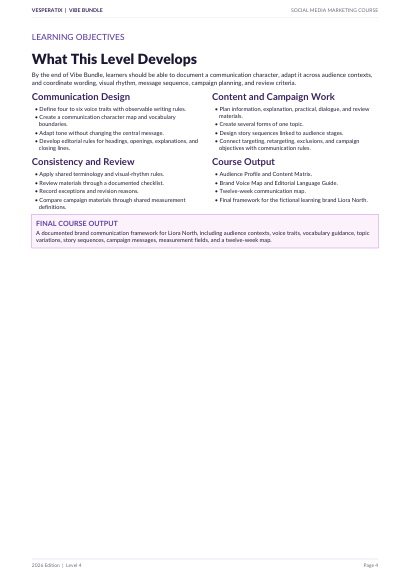
- describe four to six project voice characteristics;
- create a vocabulary guide with recommended and avoided wording;
- adapt one topic for at least three audience groups;
- prepare an editorial guide containing ten or more rules;
- create five presentation formats for one topic;
- develop three connected topic sequences;
- prepare a library containing at least twelve content scenarios;
- review ten materials using one structured checklist;
- create a twelve-week communication map;
- present a complete framework for a fictional learning project.
6. Return Terms
A refund request may be submitted within 30 days according to the terms published on the Vesperatix website. Before selecting the tier, learners should review the full conditions, request procedure, and applicable exceptions.
7. Certificate
After completing Vibe Bundle and the required learning tasks, the learner receives a Vesperatix certificate displaying the course name.
1. Is previous SMM experience required?
1. Is previous SMM experience required?
No, the materials follow a structured order and begin with foundational concepts. Each tier explains its topics through focused theory sections, examples, and practical tasks. Learners with previous experience may also use the courses to organize and review their knowledge.
2. How are the materials presented?
2. How are the materials presented?
Each tier contains structured lessons, topic-based modules, examples, tables, review questions, and practical exercises. The amount of material depends on the selected tier. Higher tiers cover a broader range of topics and include more detailed learning tasks.
3. Is a certificate provided after completion?
3. Is a certificate provided after completion?
Yes, after completing the materials and the required tasks, the learner receives a Vesperatix certificate showing the name of the completed course.
Share