Vesperatix
LUMA SET
LUMA SET
Couldn't load pickup availability
- 📘 Digital file available after purchase
- ♾️ Long-term availability
- 🔒 Secure checkout
- 🗓️ Content updated in 2026
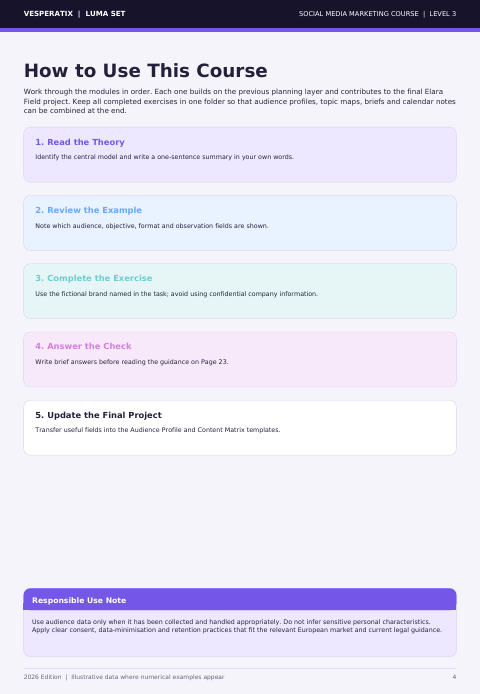
Self-paced learning overview
1. Problem Statement
Even when a content plan already exists, individual materials may remain disconnected from one another. Topics are often selected situationally without considering earlier messages or the next stage of audience communication. As a result, content categories may function separately, while the overall project structure loses consistency. Learners may also find it difficult to divide resources between writing, visual preparation, review, and analysis. Without an editorial cycle, maintaining regular work, recording changes, and adjusting future plans becomes more complicated.
2. Solution
Luma Set explains how to turn separate topics into a connected content system. Learners create topic series, define transitions between materials, and organize editorial cycles. Dedicated modules explain task distribution, content briefs, and pre-publication review. The course also introduces the comparison of audience responses through shared criteria and structured observation notes. The final project combines a topic map, calendar, briefs, review rules, and analytical observations.
3. What’s Inside
-
Module 1: Content System Overview
Learners will review the main parts of a content system and define connections between objectives, audience questions, categories, and individual materials. -
Module 2: Audience Context Layers
This module explains how to consider subject familiarity, previous knowledge, common objections, and information needs across different audience groups. -
Module 3: Topic Relationship Map
Learners will create a map of related topics and build logical transitions from introductory explanations to more detailed materials. -
Module 4: Content Series Design
This module focuses on planning connected series in which each material has a defined role and continues the previous topic. -
Module 5: Editorial Cycle Planning
Learners will divide the workflow into topic research, preparation, editing, review, date planning, and final evaluation. -
Module 6: Content Brief Structure
The materials show how to prepare a working brief containing the topic, objective, audience group, central idea, structure, and content requirements. -
Module 7: Format Selection Logic
Learners will review how to choose a format according to topic complexity, information volume, and the intended audience action. -
Module 8: Editorial Quality Review
This module supports the review of clarity, logic, repetition, communication tone, topic relevance, and readability. -
Module 9: Observation and Comparison
Learners will compare several materials using shared criteria and record meaningful differences in an observation table. -
Module 10: Content Adjustment Notes
This module explains how to document reasoned changes to topics, structure, formats, and the editorial calendar. -
Module 11: Eight-Week Editorial Map
Learners will prepare an eight-week practice plan containing topic series, categories, formats, and preparation stages. -
Module 12: Final Content System Project
The final module combines all completed elements into one structured model for a fictional project.
4. Who Is This For?
✅ Suitable if you:
- already know how to prepare a foundational content plan;
- want to connect separate topics into structured series;
- plan to organize an editorial workflow;
- want to work with detailed content briefs;
- need a clear material review system;
- are ready to use tables, maps, and observation notes;
- want to prepare a plan across several editorial cycles.
❌ Not suitable if you:
- are only beginning to study SMM terminology;
- need a brief overview without practical tasks;
- do not plan to work with a long-form calendar;
- do not want to create connected topic series;
- expect individual management of a real project;
- are not prepared to review and adjust your materials;
- need only ready-written texts without structural explanations.
5. What You’ll Learn
Specific Skills and Knowledge
- building a connected content system;
- defining context for different audience groups;
- creating a related-topic map;
- planning structured content series;
- organizing an editorial cycle;
- preparing detailed content briefs;
- choosing formats through defined criteria;
- reviewing material logic and readability;
- comparing audience responses;
- documenting editorial changes;
- preparing an eight-week calendar;
- assembling a final content workflow model.
Measurable Learning Indicators
After completing the tier, the learner will be able to:
- describe four audience context groups;
- create a map containing at least twenty connected topics;
- prepare three content series with five materials in each;
- complete six detailed content briefs;
- organize an editorial cycle with defined stages and dates;
- create a review checklist containing ten criteria;
- compare at least eight materials in an observation table;
- document editorial changes and explain the reasoning behind each one;
- prepare an eight-week content map;
- present a complete system for a fictional learning project.
6. Return Terms
A refund request may be submitted within 30 days according to the terms published on the Vesperatix website. Before selecting the tier, learners should review the full conditions, request procedure, and applicable exceptions.
7. Certificate
After completing Luma Set and the required learning tasks, the learner receives a Vesperatix certificate displaying the course name.
1. Is previous SMM experience required?
1. Is previous SMM experience required?
No, the materials follow a structured order and begin with foundational concepts. Each tier explains its topics through focused theory sections, examples, and practical tasks. Learners with previous experience may also use the courses to organize and review their knowledge.
2. How are the materials presented?
2. How are the materials presented?
Each tier contains structured lessons, topic-based modules, examples, tables, review questions, and practical exercises. The amount of material depends on the selected tier. Higher tiers cover a broader range of topics and include more detailed learning tasks.
3. Is a certificate provided after completion?
3. Is a certificate provided after completion?
Yes, after completing the materials and the required tasks, the learner receives a Vesperatix certificate showing the name of the completed course.
Share