Vesperatix
CLOUD PATHWAY
CLOUD PATHWAY
Couldn't load pickup availability
- 📘 Digital file available after purchase
- ♾️ Long-term availability
- 🔒 Secure checkout
- 🗓️ Content updated in 2026
Self-paced learning overview
1. Problem Statement
A large SMM system may include several campaigns, topic directions, audience groups, and editorial teams working at the same time. Each part may use its own calendar, rules, indicators, and working order, making the overall structure difficult to review. Information about topics, materials, statuses, changes, and decisions may be stored across separate documents without one organizational principle. This can make it harder for teams to coordinate priorities, maintain a shared style, and understand dependencies between different directions. Without a central model, regular reviews, material updates, and long-term editorial decisions become more difficult to organize and explain.
2. Solution
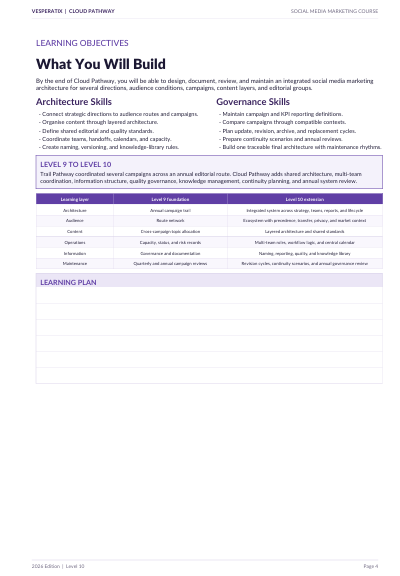
Cloud Pathway provides a comprehensive learning model for designing a multi-layer SMM system. Learners create a central map connecting strategic directions, campaigns, audience routes, content categories, roles, and review points. The course explains how to form shared editorial standards, coordinate several calendars, and document changes within one structured framework. Dedicated modules cover resource planning, reporting, material archiving, regular reviews, and update scenarios. The final project combines an annual map, governance system, rule set, analytical documents, and a complete content coordination model.
3. What’s Inside
-
Module 1: Integrated SMM Architecture
Learners will examine how strategy, campaigns, materials, roles, and analytical observations connect within one system. -
Module 2: Strategic Direction Network
This module explains how to build a network of long-term directions and connect each one with relevant audience groups and topic areas. -
Module 3: Audience Ecosystem Map
Learners will create an extended audience map covering different levels of subject familiarity, information needs, questions, and interaction routes. -
Module 4: Campaign System Design
This module helps learners organize several campaigns by role, timeframe, topic, audience, and position within the wider system. -
Module 5: Content Architecture Layers
Learners will organize content across strategic directions, campaigns, series, individual materials, and supporting resources. -
Module 6: Editorial Standards Framework
The materials show how to create shared rules for terminology, message structure, tone, presentation, review, and documentation. -
Module 7: Multi-Team Role Coordination
Learners will define roles, responsibilities, task handoffs, and approval points for several editorial groups. -
Module 8: Central Editorial Calendar
This module focuses on creating a central calendar that combines campaigns, topic periods, deadlines, statuses, and review points. -
Module 9: Resource and Capacity Mapping
Learners will estimate material volume, editorial workload, preparation periods, and the need for additional working resources. -
Module 10: Workflow Automation Logic
This module explains how to describe repeating actions, status transitions, reminders, reviews, and handoff rules without relying on named software. -
Module 11: Information Structure and Naming
Learners will create naming, category, code, version, and folder rules for organizing editorial documents. -
Module 12: Central Reporting System
This module shows how to prepare regular reports by campaign, team, audience route, calendar period, and editorial change. -
Module 13: Content Quality Governance
Learners will prepare review rules covering logic, clarity, topic relevance, tone, structure, and editorial consistency. -
Module 14: Cross-Campaign Analysis
This module focuses on comparing several campaigns through shared criteria while keeping separate objectives and audience contexts distinct. -
Module 15: Knowledge Library Structure
Learners will create an internal library containing editorial rules, topic maps, briefs, examples, reports, and decision logs. -
Module 16: Update and Revision Cycles
This module explains how to schedule regular reviews of topics, materials, calendars, audience descriptions, and working rules. -
Module 17: Archive and Content Lifecycle
Learners will define a process for creating, using, revising, combining, archiving, and reviewing materials. -
Module 18: Scenario and Continuity Planning
This module supports the preparation of alternative working scenarios for changes in timing, priorities, material volume, or team structure. -
Module 19: Annual Governance Review
Learners will develop an annual review format covering strategic directions, campaigns, editorial standards, workflows, and learning observations. -
Module 20: Final Cloud Content System
The final module combines the strategic network, audience map, campaign system, central calendar, roles, reporting, material library, and update rules.
4. Who Is This For?
✅ Suitable if you:
- already work with several campaigns and long-term calendars;
- want to connect different content directions within one system;
- coordinate several participants or editorial groups;
- need a central structure for materials, statuses, and decisions;
- want to create shared editorial standards;
- plan to organize reporting and regular reviews;
- work across an extended planning period;
- are ready to create maps, guidelines, tables, and review documents;
- want to organize the full lifecycle of content;
- need a model for the continued development of an SMM system.
❌ Not suitable if you:
- are only beginning to study SMM;
- have not worked with content plans;
- need a brief introductory resource;
- need only separate topics or prepared texts;
- do not plan to work with a long-term structure;
- do not want to document editorial rules;
- are not ready to coordinate several working directions;
- expect individual management of a real project;
- do not plan to conduct regular reviews and updates.
5. What You’ll Learn
Specific Skills and Knowledge
- designing an integrated SMM architecture;
- creating a network of strategic directions;
- building an extended audience map;
- organizing a multi-campaign system;
- dividing content across structural layers;
- forming shared editorial standards;
- coordinating roles across several groups;
- creating a central editorial calendar;
- planning editorial capacity;
- describing repeating workflows;
- organizing names, categories, and versions;
- preparing centralized reports;
- creating material review rules;
- comparing campaigns through shared criteria;
- building an internal knowledge library;
- planning revision cycles;
- managing the content lifecycle;
- preparing alternative working scenarios;
- conducting an annual review;
- assembling a complete SMM system model.
Measurable Learning Indicators
After completing the tier, the learner will be able to:
- create a map containing at least six strategic directions;
- describe five to eight audience groups;
- build a system containing at least six connected campaigns;
- distribute one hundred or more topics across directions, series, and campaigns;
- prepare an editorial guide containing twenty or more rules;
- define roles and responsibilities for six participants;
- create a central twelve-month calendar;
- prepare an editorial capacity map;
- describe at least ten repeating workflows;
- form a naming, version, and category system;
- prepare six regular reports;
- create a checklist containing fifteen review criteria;
- compare at least four campaigns;
- organize a library with five main sections;
- prepare a material revision schedule;
- document the lifecycle of twenty materials;
- prepare three alternative working scenarios;
- conduct a structured annual review;
- present a complete model for a fictional learning project.
6. Return Terms
A refund request may be submitted within 30 days according to the terms published on the Vesperatix website. Before selecting the tier, learners should carefully review the full conditions, request procedure, and applicable exceptions.
7. Certificate
After completing Cloud Pathway and the required learning tasks, the learner receives a Vesperatix certificate displaying the course name.
1. Is previous SMM experience required?
1. Is previous SMM experience required?
No, the materials follow a structured order and begin with foundational concepts. Each tier explains its topics through focused theory sections, examples, and practical tasks. Learners with previous experience may also use the courses to organize and review their knowledge.
2. How are the materials presented?
2. How are the materials presented?
Each tier contains structured lessons, topic-based modules, examples, tables, review questions, and practical exercises. The amount of material depends on the selected tier. Higher tiers cover a broader range of topics and include more detailed learning tasks.
3. Is a certificate provided after completion?
3. Is a certificate provided after completion?
Yes, after completing the materials and the required tasks, the learner receives a Vesperatix certificate showing the name of the completed course.
Share