Vesperatix
CIPHER MODULE
CIPHER MODULE
Couldn't load pickup availability
- 📘 Digital file available after purchase
- ♾️ Long-term availability
- 🔒 Secure checkout
- 🗓️ Content updated in 2026
Self-paced learning overview
1. Problem Statement
Long-term content work produces a growing collection of metrics, comments, responses, and editorial notes. Without one shared system, these data points remain disconnected and provide little explanation of why one material received more interaction than another. Individual indicators are often reviewed without considering the topic, message structure, audience context, or publication timing. As a result, content plan changes may be based on assumptions rather than structured analysis. It can also be difficult to separate a temporary fluctuation from a repeating pattern that deserves further study.
2. Solution
Cipher Module provides a structured system for collecting, grouping, and interpreting content observations. Learners define comparison criteria, create tables, and review indicators in relation to topic, format, and audience group. Dedicated modules explain how to formulate working hypotheses and examine them through small learning studies. The course also covers documenting findings, maintaining a decision log, and preparing concise analytical reviews. The final project combines a metric map, comparison system, hypothesis set, and plan for future editorial actions.
3. What’s Inside
-
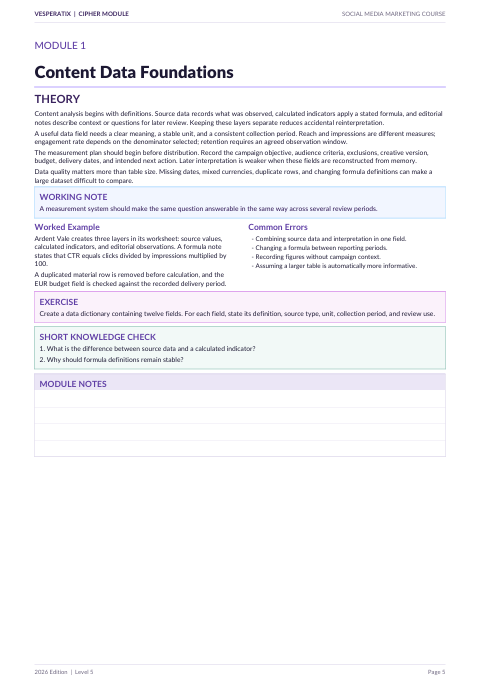
Module 1: Content Data Foundations
Learners will review the main types of content data and determine which observations may support later analysis. -
Module 2: Metric Context Map
This module explains how to connect indicators with topic, format, audience group, publication timing, and material purpose. -
Module 3: Observation Framework
Learners will create one shared structure for recording indicators, comments, editorial notes, and contextual factors. -
Module 4: Comparison Criteria
This module focuses on selecting consistent criteria for comparing several materials without combining unrelated parameters. -
Module 5: Pattern Recognition
Learners will identify repeating connections between topics, message structures, formats, and audience responses. -
Module 6: Hypothesis Building
The materials show how to turn observations into clear working assumptions that can be examined through learning practice. -
Module 7: Controlled Content Comparison
Learners will prepare several versions of a material with one changed characteristic and compare the responses using shared criteria. -
Module 8: Audience Response Notes
This module supports the review of comments, questions, and other responses without making broad conclusions from isolated cases. -
Module 9: Content Performance Review
Learners will prepare a structured review of materials with concise explanations of topic, format, structure, and observed differences. -
Module 10: Decision Log
This module explains how to maintain an editorial decision log containing dates, reasons, expected changes, and later observations. -
Module 11: Reporting Structure
Learners will prepare concise analytical reports containing source data, observations, working assumptions, and next actions. -
Module 12: Final Analysis Framework
The final module combines tables, criteria, comparisons, hypotheses, findings, and an editorial plan for a fictional project.
4. Who Is This For?
✅ Suitable if you:
- already work with content plans and connected topic series;
- want to organize collected indicators and observations;
- want to understand relationships between content and audience responses;
- are ready to work with tables, logs, and comparison criteria;
- want to formulate and examine working hypotheses;
- plan to document editorial decisions;
- need a clear structure for analytical reviews;
- want to make reasoned adjustments to a content system.
❌ Not suitable if you:
- are only beginning to study SMM foundations;
- do not plan to collect and compare content indicators;
- need only ready-written materials or topic ideas;
- do not want to work with tables and written findings;
- expect automatic interpretation of every indicator;
- are not ready to examine assumptions through learning comparisons;
- need only a brief introductory resource.
5. What You’ll Learn
Specific Skills and Knowledge
- identifying useful content indicators;
- creating a map of contextual factors;
- maintaining one structured observation table;
- defining comparison criteria;
- identifying repeating patterns;
- formulating working hypotheses;
- preparing controlled comparisons;
- reviewing audience responses;
- creating a content review;
- maintaining an editorial decision log;
- preparing a concise analytical report;
- assembling a complete analysis framework.
Measurable Learning Indicators
After completing the tier, the learner will be able to:
- identify eight to twelve indicators for observation;
- create a table covering at least twenty materials;
- describe each material through five or more contextual parameters;
- define ten comparison criteria;
- identify and describe at least five repeating patterns;
- formulate six working hypotheses;
- prepare three learning comparisons;
- create a log containing ten editorial decisions;
- complete an analytical review with findings and next actions;
- present a final analysis framework for a fictional project.
6. Return Terms
A refund request may be submitted within 30 days according to the terms published on the Vesperatix website. Before selecting the tier, learners should review the full conditions, request procedure, and applicable exceptions.
7. Certificate
After completing Cipher Module and the required learning tasks, the learner receives a Vesperatix certificate displaying the course name.
1. Is previous SMM experience required?
1. Is previous SMM experience required?
No, the materials follow a structured order and begin with foundational concepts. Each tier explains its topics through focused theory sections, examples, and practical tasks. Learners with previous experience may also use the courses to organize and review their knowledge.
2. How are the materials presented?
2. How are the materials presented?
Each tier contains structured lessons, topic-based modules, examples, tables, review questions, and practical exercises. The amount of material depends on the selected tier. Higher tiers cover a broader range of topics and include more detailed learning tasks.
3. Is a certificate provided after completion?
3. Is a certificate provided after completion?
Yes, after completing the materials and the required tasks, the learner receives a Vesperatix certificate showing the name of the completed course.
Share